
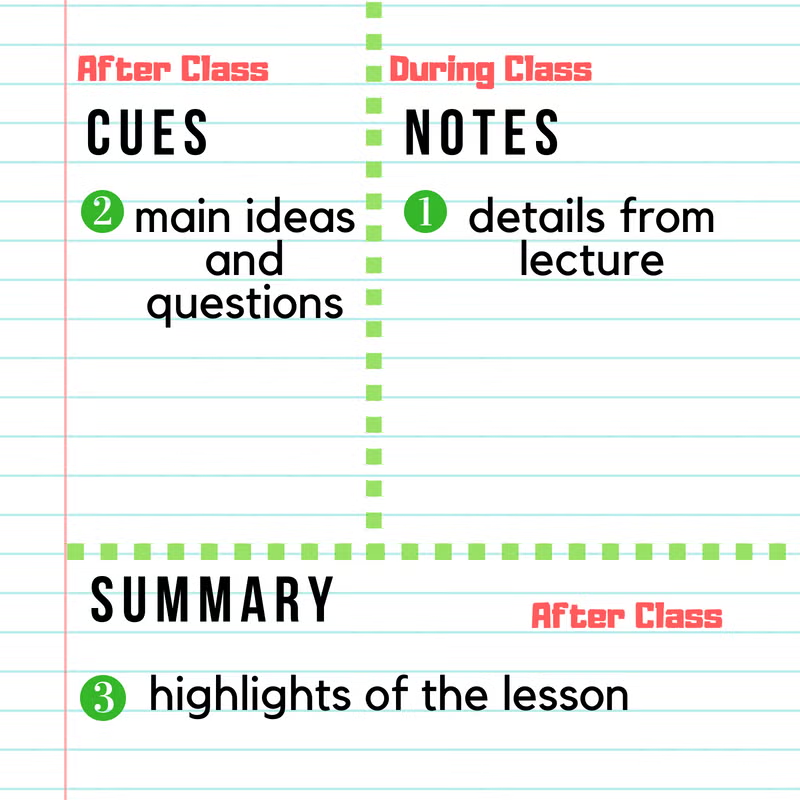
Jakarta, inca.ac.id – University learning moves quickly. Lecturers present large amounts of information, readings build from week to week, and students are expected to understand, retain, and apply ideas independently. In that environment, strong Lecture Notes become more than a classroom habit. They become an essential academic tool. Well-organized notes help students capture key concepts, review lessons efficiently, prepare for exams, and stay engaged with course material over time. Good note-taking is not about writing down every word. It is about creating a system that turns lectures into usable knowledge.
Why Lecture Notes Matter

Lecture Notes matter because they help students process information actively rather than passively. During a lecture, students are often listening, thinking, identifying important points, and connecting new ideas with previous learning at the same time. A good note-taking method supports this process by helping students record the most relevant material clearly and logically.
This becomes especially important because university courses often require students to study from multiple sources, including lectures, readings, slides, and discussions. Without organized notes, review becomes more difficult, and important concepts may be forgotten. Strong lecture notes help reduce confusion and make revision more focused and efficient.
There is also a strong connection to study skills, exam preparation, classroom learning, academic organization, note-taking strategies, memory retention, time management, and university success here. A strong understanding of Lecture Notes is not simply about writing during class. It is about improving how students learn and review.
My Perspective on Effective Note-Taking
What changed my understanding of Lecture Notes was realizing that the best notes are not always the longest ones. At first, some students try to record nearly everything the lecturer says. But over time, it becomes clear that useful notes are selective, structured, and easy to revisit. Notes should help the brain later, not impress it in the moment. A notebook full of chaos may be emotionally honest, but academically unhelpful.
That is what makes this topic meaningful. Lecture notes are not only a record of class. They are also a study system.
Core Purposes of Lecture Notes
The value of Lecture Notes becomes clearer when their main academic functions are broken down directly.
Capturing key concepts
Notes help students record the central ideas discussed in class.
Supporting understanding
Writing and organizing information improves mental processing.
Making review easier
Clear notes reduce time wasted when preparing for tests or assignments.
Connecting lecture and reading material
Students can integrate class explanations with textbook content.
Tracking course progress
Notes create a record of what has been taught over time.
Smart Ways to Organize Lecture Notes
I believe Lecture Notes become most effective when students use a structure that makes review fast and meaningful.
Use clear headings and dates
This helps students locate topics quickly later.
Separate main ideas from details
Key concepts should stand out visually.
Use bullet points and abbreviations
This keeps note-taking efficient during fast lectures.
Highlight examples and definitions
Important supporting points should be easy to find.
Review and rewrite when needed
Editing notes after class improves clarity and retention.
Smart Ways to Review Lessons from Notes
I have noticed that Lecture Notes are most useful when students do more than simply store them.
Review notes within 24 hours
Early review strengthens memory.
Summarize each lecture in a few sentences
This helps confirm understanding.
Turn notes into questions
Self-testing improves recall more than rereading alone.
Compare notes with course materials
This helps fill gaps and confirm accuracy.
Create topic-based review sheets
Combining related notes supports exam preparation.
Below is a simple overview of good note-taking practice:
| Lecture Notes Strategy | Why It Matters | Example in Practice |
|---|---|---|
| Clear organization | Makes review faster | Notes are labeled by course, topic, and date |
| Selective writing | Focuses attention on key material | A student records major concepts instead of every sentence |
| Post-class review | Improves memory and understanding | Notes are revised later the same day |
| Visual structure | Helps important ideas stand out | Headings, bullets, and highlights separate main points |
| Active recall | Strengthens long-term retention | A student quizzes themselves using note-based questions |
These examples show that Lecture Notes are not simply written records of lectures. They are a practical academic tool that helps students organize knowledge, strengthen understanding, and review lessons more effectively.
Why Lecture Notes Matter Beyond the Classroom
The importance of Lecture Notes extends beyond class sessions themselves. Good notes improve independent study, support assignment preparation, and make exam revision much more manageable. They also help students become more active, responsible learners over time.
That broader significance is what makes this topic so valuable. Lecture notes are not only about recording what was said in class. They are also about building a stronger system for academic success.
Final Thoughts
For me, Lecture Notes are one of the smartest academic tools university students can develop because they turn fast-moving lessons into organized, reviewable learning. By using better structure, clearer review habits, and more active note-taking strategies, students can study more effectively and with greater confidence.
That is why it matters so much. Lecture Notes are not simply notes. They are a foundation for stronger understanding, better revision, and more successful university learning.
Explore our “”Knowledge“” category for more insightful content!
Don't forget to check out our previous article: Orientation Week: Helping University Students Adjust to Campus Life and Academic Rules
Penulis

#academic organization #classroom learning #exam preparation #Lecture Notes #memory retention #note-taking strategies #study skills #university students
Related Posts
 Kuliah Perdana Menjadi Langkah Awal Mahasiswa Mengenal Sistem Belajar dan Kehidupan Kampus
 Ilmu Kesehatan Anak Membantu Mahasiswa Memahami Kesehatan dan Perawatan Anak Sejak Dini
 Sosial Ekonomi Perikanan Membantu Mahasiswa Memahami Usaha, Masyarakat, dan Kehidupan di Sektor Perikanan
 Manajemen Pariwisata Membantu Mahasiswa Memahami Cara Mengelola Usaha dan Layanan Wisata